Breaking Norms
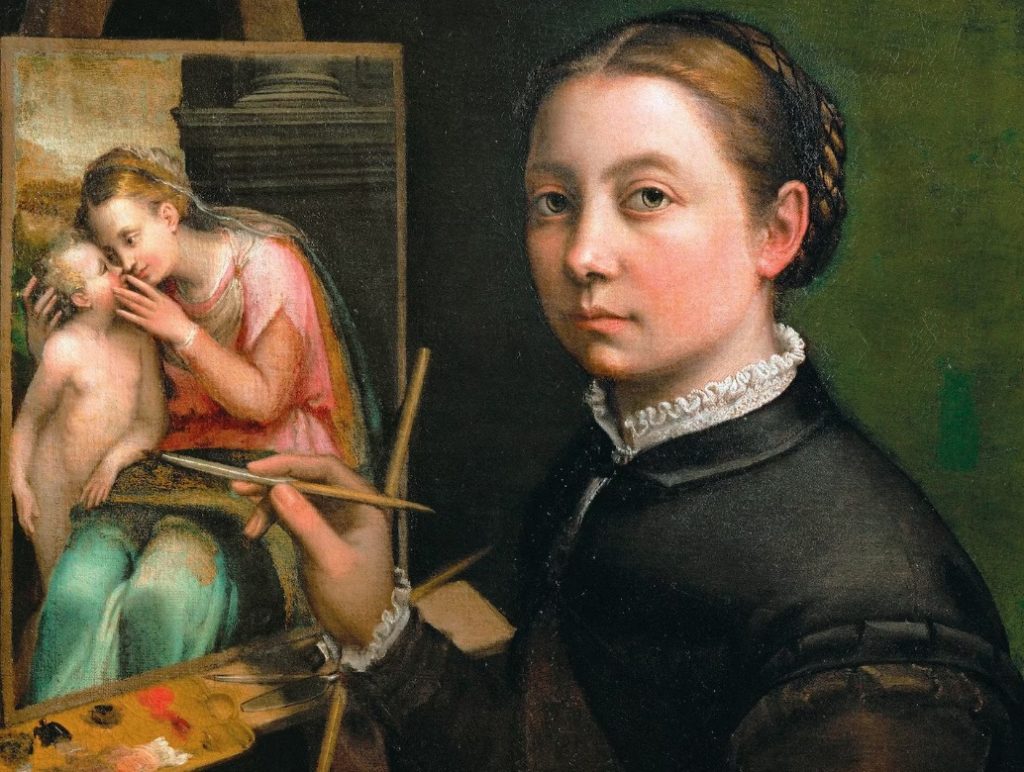
In the world of art, there are groundbreaking works that not only leave a lasting impact on the artistic landscape but also break barriers and challenge societal norms. One such work is the painting titled “Self-Portrait at the Easel” by Sofonisba Anguissola, a remarkable late Renaissance painter known for her contribution to Mannerism and her significant place in the history of art.
Sofonisba Anguissola, born in 1532 in the city of Cremona in Lombardy, Italy, hailed from an extraordinary family. The Anguissola family, with roots dating back to the Byzantine noble family, had a rich and unique heritage. Sofonisba’s father, Amilcare Anguissola, a nobleman from Carmona, had a progressive outlook and believed in providing his daughters with the same opportunities as his son. Thus, Sofonisba and her six siblings received a humanistic education, a privilege rarely afforded to women at the time.
Recognizing Sofonisba’s exceptional talent in painting, her father entrusted her to Bernardino Campi, a renowned painter from Cremona, when she was just 14 years old. Sofonisba’s progress was rapid, and at the age of 22, against societal norms, her father allowed her to travel alone to Rome in pursuit of her artistic career. In Rome, she had the opportunity to meet and be mentored by none other than Michelangelo himself, who recognized her talent and guided her development from a distance by sending her his own sketches.
The painting “Self-Portrait at the Easel” was created by Sofonisba Anguissola in 1556 when she was 24 years old. This remarkable self-portrait, an oil painting on canvas measuring 66×57 cm, showcases her skill and mastery as an artist. It depicts Sofonisba at work, standing confidently before her easel, capturing her focused and determined expression. It is a testament to her artistic prowess and serves as a milestone in her career.
The painting found great admiration from the 3rd Duke of Alba, Fernando Alvarez de Toledo, who invited Sofonisba to Milan to paint his portrait. The Duke, impressed by her talent, recommended her to the King of Spain, Philip II. Subsequently, Sofonisba was appointed as a mentor and lady-in-waiting to Queen Elizabeth de Valois, the queen consort of Spain and a budding amateur painter.
As a token of appreciation, the King of Spain arranged a prestigious marriage for Sofonisba to a wealthy nobleman from Sicily, Fabrizio Moncada Pinatelli, and provided her with a generous dowry. Sofonisba moved to Sicily and lived in her husband’s magnificent palace in Paterno. After her husband’s death in 1579, she returned to Italy, settling in Pisa and later Genoa after her marriage to Captain Horazio Lomellini.
Sofonisba Anguissola’s artistic talent and reputation as a portrait painter reached far and wide during her lifetime. She received numerous commissions from royal houses and noble families across Europe, cementing her position as a respected artist. Even male artists of her generation, such as the famed Flemish painter Anthony van Dyck, sought her guidance and acknowledged her influence.
Despite the limitations imposed on women of her time, preventing her from studying anatomy and working on large-scale religious or mythological compositions, Sofonisba broke new ground in portrait painting. She introduced various poses and backgrounds, adding depth and innovation to her portraits.
Sofonisba Anguissola lived a long and prolific life, reaching the extraordinary age of 93. She passed away in 1625 and was buried in Palermo, in the church of San Giorg