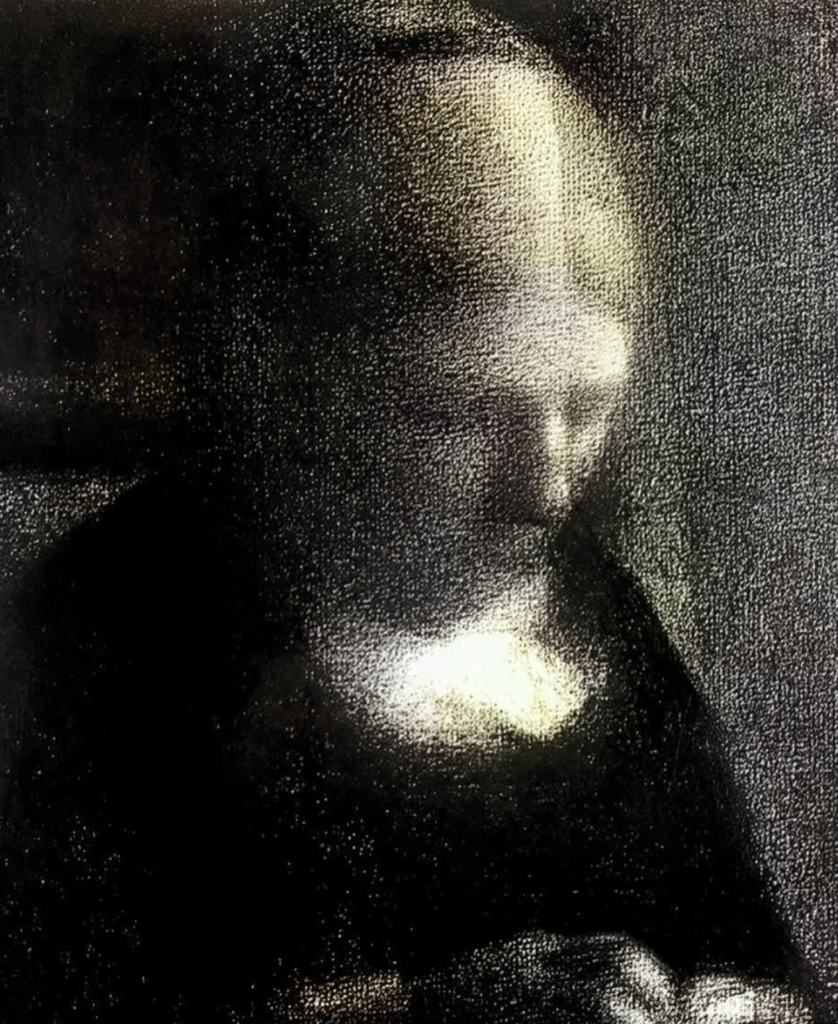
A Melancholic Revolution
Georges Pierre Seurat, a renowned post-impressionist artist, created a sketch titled “Mother Embroiders” in 1881 when he was just 20 years old. This particular drawing holds a special significance as it was dedicated to his mother, Ernestine Faibra, whom he held dear. The sketch was made using a technique developed by Seurat himself and is displayed at the Metropolitan Museum in New York.
“Mother Embroiders” is the first drawing among approximately 150 Conte drawings created by Seurat between 1880, when he opened his studio in Paris, and his untimely death in 1891 at the age of 31. The Conte pencil, used by Seurat, was not invented by him but rather by Nicolas Jacques Conte, a French chemist, in 1795. Conte developed the pencil by mixing graphite powder or compressed coal with wax or raw clay. This invention was a response to the shortage of graphite caused by the Napoleonic wars.
Seurat discovered that the Conte pencil possessed additional virtues beyond its cost-effectiveness. He found that the crushed natural charcoal used in the pencil produced a rich and soft black pigment when fired. Seurat’s unique drawing style emerged as he experimented with using Conte chalk stains on a rough paper surface, allowing him to utilize the brightness and texture of the white cardboard to create a melancholic, mysterious, and intriguing graphic texture.
The Metropolitan Museum in New York houses many of Seurat’s Conte drawings. However, the largest exhibition showcasing this technique was held at the Museum of Modern Art (MOMA) in New York from October 28, 2007, to January 7, 2008. Titled “George Seurat – The Drawings,” the exhibition featured 135 drawings by Seurat and his friend Paul Signiac, all created using the Conte technique.
Seurat’s career witnessed three major breakthroughs. Two years after creating the Conte drawings, he embarked on a second revolution alongside Paul Signiac. Together, they developed the technique of “pointillism,” in which paintings were created using small dots and isolated spots of color. These dots would blend together when viewed from a distance, forming beautiful landscapes and figures without the use of broad brushstrokes or distinct lines. Pointillism emerged around 1884 when Seurat was 25 years old.
In 1886, at the age of 27, Seurat achieved his third revolution with the completion of a monumental work measuring 3 meters by 2 meters, titled “A Sunday Afternoon on the Island of La Grande Jatte.” The painting, created using bright oil colors, made its debut at the 8th and final Impressionist exhibition held in Paris in May-June 1886. This work earned Seurat the title of “father of Neo-Impressionism.” It is currently displayed in Room 240 at the Art Institute of Chicago and has had a lasting impact, even inspiring Stephen Sondheim’s musical “Sunday in the Park with George” in 1983.
Tragically, Georges Seurat’s life was cut short when he passed away on March 29, 1891, at the age of 31, due to complications from the flu that developed into meningitis. He left behind a son named Pierre Georges, who was only one year old at the time of his father’s death. Seurat’s widow, Madeline Knobloch, who had been his favorite model, wrote a book chronicling his life story, which was subsequently translated into several languages.
Art historians consider Seurat’s revolution in Conte drawings to be of significant historical importance in his brief career. The Conte technique has continued to develop in the 130 years since Seurat’s passing. The Conte pencil, with its distinctive