Belle Epoque Masquerade
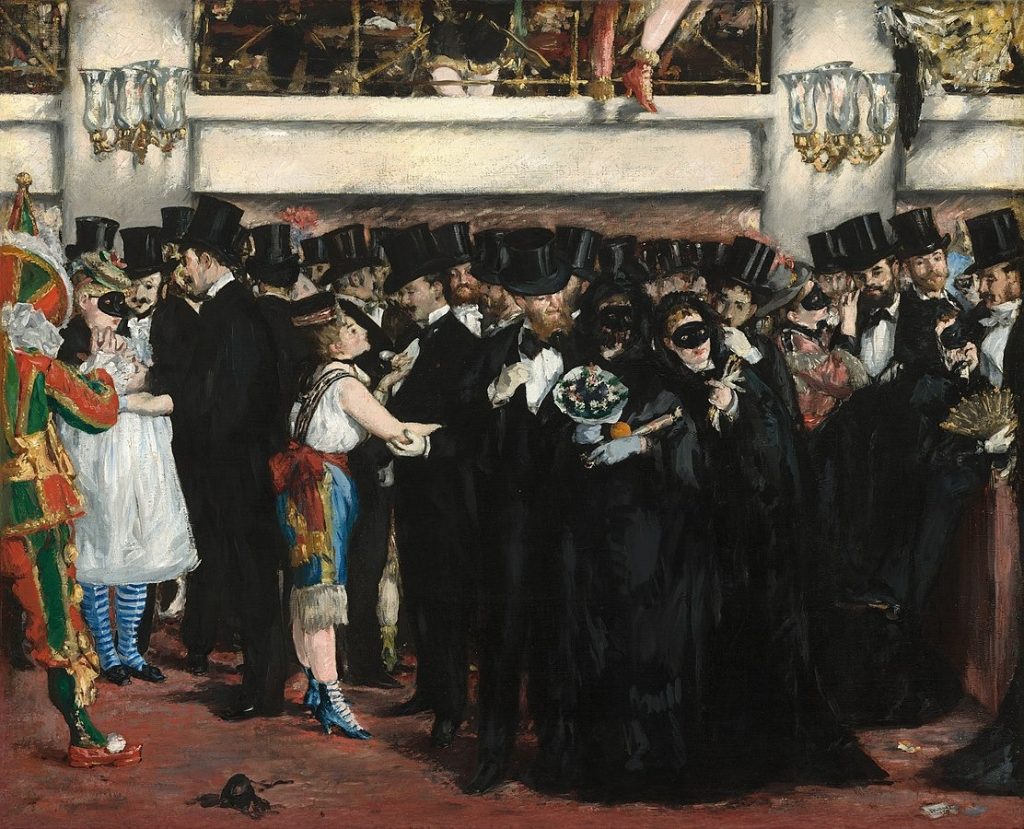
In April 1873, the renowned artist Edouard Manet attended a masquerade ball at the Paris Opera House, located on 12 La Peltier Street in the 9th arrondissement of the city. Despite the joyous celebration, tragedy would soon strike, as the opera house was engulfed in flames just two months later, leaving it in ruins. However, Manet was determined to capture the vibrant atmosphere of that night in his painting, “Masquerade Ball at the Opera House.”
Edouard Manet, a member of a family with considerable means, was known for his love of the luxurious life during the “Belle Epoque” period in Europe, which followed the Franco-Prussian War. He frequented the opera and admired the elegance of the attendees, especially during the popular mask balls held as fundraising events. The opera house was always packed to the limit, and the celebration on that particular night was nothing short of perfect.
Before completing the highly detailed painting, Manet made preparatory sketches while participating in the masquerade ball. In his new studio on D’Amsterdam Street, between District 8 and District 9, he meticulously recreated the scene, enlisting several of his close friends as models, including the art collector Rudolf Hart and the composer Emmanuel Chevrier. It is believed that Manet even included himself in the crowded scene, possibly represented as a blond, bearded man on the right, looking directly at the viewer while holding a dance card with the painter’s signature.
The painting, a horizontal format commonly used by Manet, features figures depicted at the edges, with some suddenly interrupted, a characteristic style that often challenged conservative artistic rules of the Paris Academy. The upper part of the canvas shows legs dangling over a railing, another daring artistic choice that contributed to the rejection of the painting by the official Paris Salon in 1874.
Despite the initial rejection, the painting found an appreciative buyer in the famous French opera singer, Jean-Baptiste Power, who purchased it a year later. The painting remained in his possession until at least 1900, when it was sold through a Parisian gallery to the representatives of Henry Osborne Habermeyer, a wealthy American sugar refiner. Eventually, Habermeyer’s young widow donated the painting to the “National Gallery” museum in Washington in 1982, where it still remains on permanent display today. The oil on canvas artwork measures 94×80 cm.
Beyond the painting’s exquisite details, the story of the French opera itself adds an additional layer of fascination. King Louis XIV was the one who initiated the establishment of an opera in Paris, hiring the French composer Jean-Baptiste Lully as his court conductor. In 1672, Lully was granted authorization to establish the Royal Academy of Music in Paris, which paved the way for the eventual creation of the Paris Opera Company and the opera ballet. However, the opera faced many challenges, including the need to relocate thirteen times due to numerous fires that struck its different residences.
The opera house depicted in Manet’s painting was established in 1821, but sadly, it succumbed to a devastating fire in 1873, leaving all of Paris in despair. Fortunately, the “Garnier Palace,” initiated by Emperor Napoleon III and already in advanced stages of construction, provided a new home for the opera troupe in 1875. The palace served as the troupe’s formal residence until 1989.
In later years, during the reign of the Socialist President François Mitterrand, the “Opera Bastille” was built in the Marais of Paris, becoming the main theater for the national opera and ballet companies in honor of the 200th anniversary of the French Revolution in 1779.
Manet’s “Masquerade Ball at the Opera House” not only captures a moment of joy and celebration but also serves as a testament to the ever-changing history of the French opera and the resilience of the artistic community in the face of challenges. The painting, now housed in the National Gallery in Washington, continues to be admired for its exceptional attention to detail and its portrayal of the elegance and extravagance of the Belle Epoque era.