Bonds, Politics, Legacy
Manuel Alvarez Bravo, the celebrated photographer, belonged to a family of artists who were pioneers of modernist photography between the two world wars. His lens captured the poetic beauty of the Aztecs, Mayans, Incas, and numerous Native American tribes across North and South America. Considered a central figure in the artistic revival after the Mexican revolution, Bravo was a follower and student of Diego Rivera, sharing his communist ideals.
Diego Rivera, a prominent painter and Frida Kahlo’s husband, had a long-standing connection with Pablo Picasso. They first crossed paths in 1909 while Rivera resided in Paris among the avant-garde artists who shaped modernism. Amedeo Modigliani, Piet Mondrian, Jean Cocteau, Georges Braque, and Picasso formed a close-knit circle, facilitated by the Jewish writer and poet, Max Jacob. Over time, Rivera and Picasso discovered their shared political views, strengthening their friendship.
Pablo Picasso, renowned for his artistic genius, created the famous painting “L’Acrobate” in 1930. The work, an amalgamation of cubism and surrealism, showcased his innovative style during that era. Though not a formal member of the surrealist movement, Picasso maintained friendships with its leaders. In 1925, he exhibited at the first surrealist exhibition in Paris, captivating audiences with his originality.
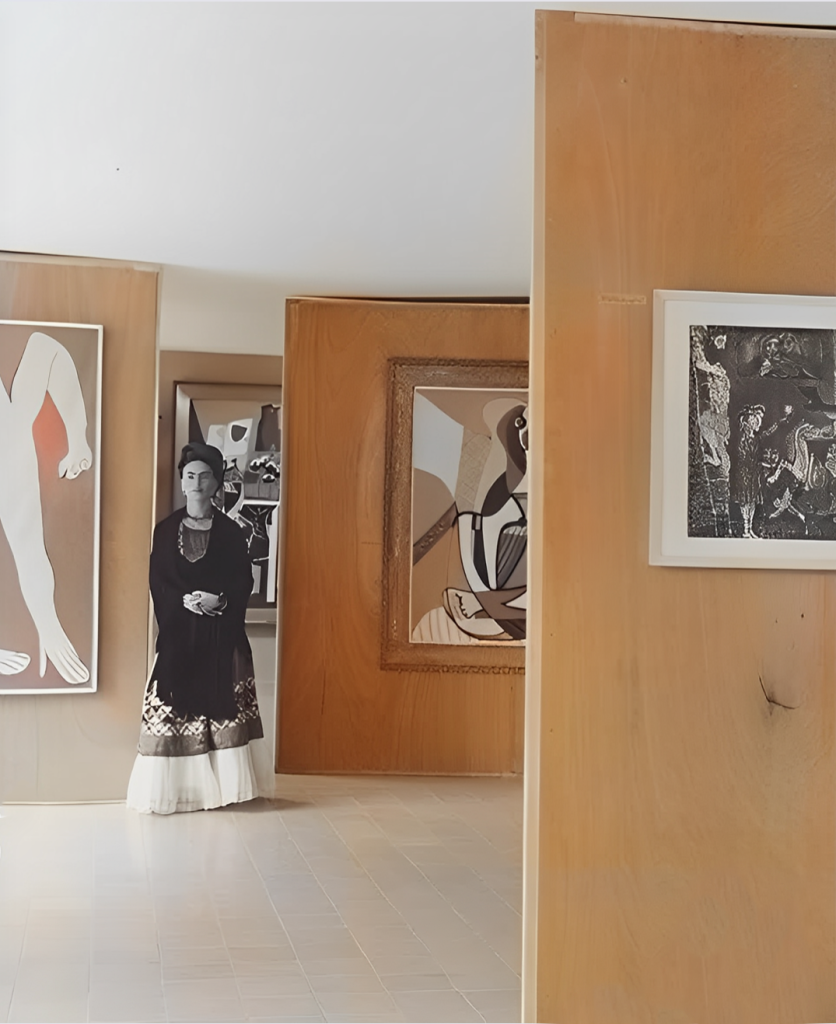
When Picasso’s masterpiece was displayed at the Mexican exhibition, Manuel Alvarez Bravo seized the opportunity to create an iconic photograph. He positioned Frida Kahlo in front of the painting, accentuating the acrobat’s impossible flexibility juxtaposed against Frida’s physical limitations. Polio as a child and a severe bus accident at 18 had confined Frida to a life of chronic pain and restricted mobility. Bravo’s photograph immortalized this striking contrast.
The bond between Frida Kahlo and Pablo Picasso blossomed in 1938 during the visit of surrealist writer Andre Breton to Mexico City. Breton was captivated by Kahlo’s naive works, which he considered unique and profound. A year later, he invited her to Paris, where she befriended influential artists like Marc Chagall, Piet Mondrian, and, of course, Pablo Picasso. As World War II loomed, Mexico maintained its neutrality, even after the election of President Manuel Avila Camacho, who sought political reform.
In 1944, as Picasso joined the French Communist Party, his renewed closeness with Diego Rivera and Frida Kahlo led to the inception of the intriguing Picasso exhibition. Rivera, a driving force behind the event, orchestrated its grand opening in a rented hall by the “Modern Art Society de Mexico.” The exhibition was an instant success, attracting art enthusiasts from all walks of life.
During the exhibition’s opening night, Manuel Alvarez Bravo captured the iconic photograph that would become a testament to the bond between these four influential creators. Frida Kahlo, at the age of 37, stood proudly in front of Picasso’s “L’Acrobate,” symbolizing strength and resilience despite her physical limitations. Behind her, the work of two artistic titans, Picasso and Rivera, loomed, echoing the interplay of politics and art.