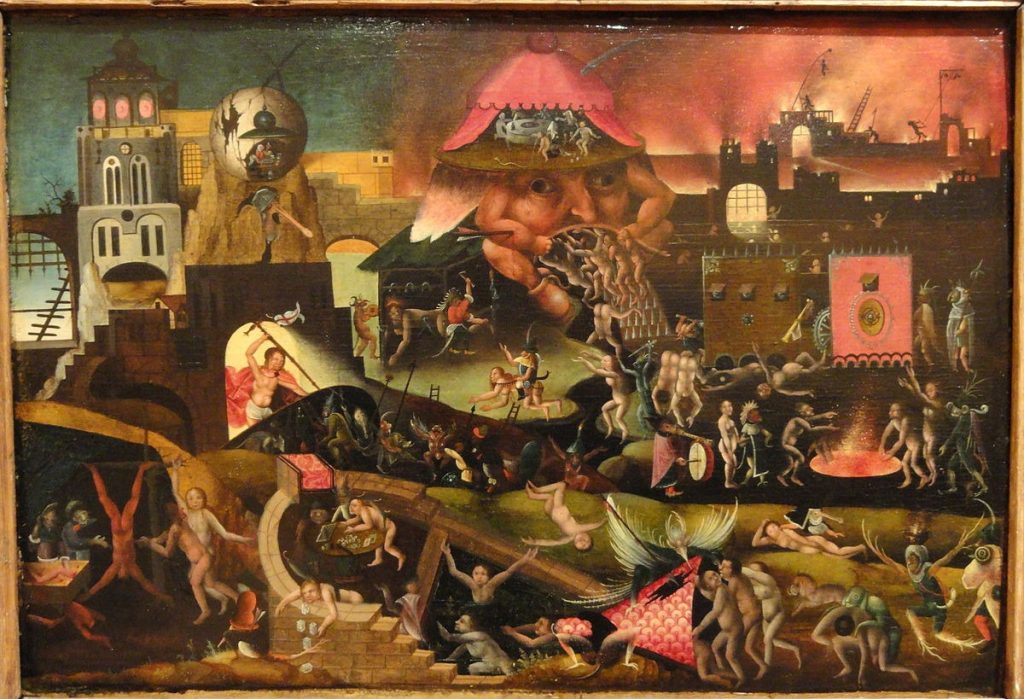
Bosch’s Symbolic Satire
Hieronymus Bosch, born Hieronymus (Jeroen) van Aken, was a renowned and prolific Dutch painter in the 15th and 16th centuries. Despite very little known about his personal life, Bosch left behind a significant body of work that showcased his unique artistic vision. He hailed from a family of Flemish painters and was one of the first world landscape painters. Bosch’s artworks primarily focused on themes of sin and human moral flaws, presenting complex and original images laden with symbols that often perplexed his contemporaries. His paintings would later inspire the Surrealism movement of the 20th century.
Early Life and Influences:
Hieronymus Bosch was born into a family of painters, with his father Antonis van Aken and grandfather Jan van Aken being established artists. His brothers and three of his uncles also pursued careers in painting. Bosch spent most of his years in his hometown of ‘s-Hertogenbosch, also known as Den Bosch, located in the center of present-day Netherlands. The city’s name would later serve as the artist’s surname, signifying his connection to his birthplace. At the age of 13, Bosch witnessed a devastating fire that consumed approximately 4,000 houses in the city, an event that may have influenced his artistic sensibilities.
Artistic Career and the Brotherhood of “Our Lady”:
Bosch emerged as a popular painter and received invitations to create artworks outside of his native country. In 1488, he joined the brotherhood of “Our Lady,” a conservative Christian group in which many of the city’s dignitaries were members. This affiliation indicates Bosch’s association with the religious and social institutions of his time.
The Garden of Earthly Delights and Illusionary Art:
One of Bosch’s most famous works is the triptych known as “The Garden of Earthly Delights.” This masterpiece consists of three interconnected wooden panels, each showcasing intricate and allegorical scenes. Bosch’s art is characterized by its fantastical and symbolic imagery, often depicting hybrid creatures and grotesque figures. However, “The Garden of Earthly Delights” diverges from his typical style, as it features fewer fantastical elements.
“The Artist of Illusions” is a notable painting series attributed to Bosch, although the original artwork has been lost, and only copies remain. This particular painting breaks away from Bosch’s usual depictions of figures and monsters, focusing instead on a magician performing tricks in front of a captivated audience. The composition is divided into two parts, with the magician symbolizing the temptations of the secular world and the crowd representing those who prioritize materialistic desires over spiritual matters.
Symbolism and Satirical Critique:
Bosch’s paintings are known for their rich symbolism, often challenging viewers to decipher their intended meanings. “The Artist of Illusions” is no exception. The painting portrays a magician performing tricks while a mesmerized audience watches, with elements such as hidden objects, scattered marbles, and frogs contributing to the enigmatic nature of the composition.
The moral nature of the painting becomes evident as Bosch juxtaposes the magician on the right side and the audience on the left. The magician symbolizes the allure of secular temptations, while the crowd represents those who prioritize materialistic pursuits over spiritual growth. Facial expressions play a crucial role in emphasizing the contrast between these two worlds, with the magician’s face obscured and mysterious, and the audience’s faces marked by strangeness and potential ignorance.
The painting can be interpreted as a satirical criticism of the bourgeois and carnal society of Bosch’s time.