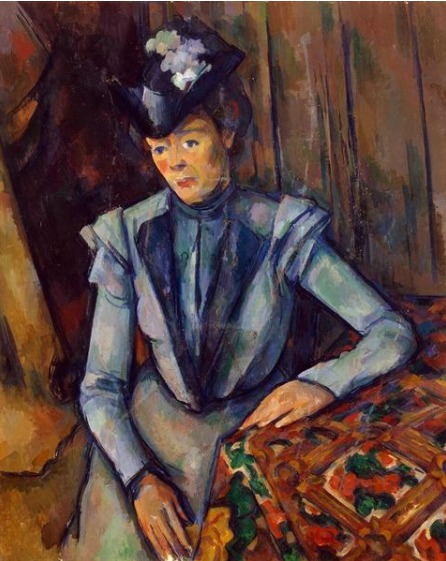
Cézanne’s Last Portrait
The painting “Lady in Blue” (also known as “Lady in Blue Dress”) was created by the renowned French artist Paul Cézanne in the year 1900. It stands as one of Cézanne’s last female portrait paintings, reflecting his late period, which spanned from 1890 to 1906. During this phase of his career and life, Cézanne’s works were imbued with lyricism and displayed a distinctive artistic style.
The subject of the painting is Madame Bremont, who served as the faithful nanny in Cézanne’s household. She was a simple and kind-hearted woman who was deeply cherished and loved by Cézanne’s family. In “Lady in Blue,” Madame Bremont appears somber, yet dignified. A sense of weariness is evident in her facial expression and motionless posture, inviting the viewer to empathize with her emotions. Dressed modestly and with a fashionable hat, she exudes an air of respectability, as though she were on her way to attend a church service. However, an underlying aura of sadness permeates her appearance, shrouding her in mystery.
The question of where this intriguing painting was created had puzzled many experts, with some suggesting that it may be linked to Cézanne’s “Paris pictures.” However, by 1900, Cézanne seldom visited Paris, making it unlikely that he could have completed such complex paintings during his infrequent visits. Moreover, Cézanne’s work pace had slowed considerably by this time. The mystery was eventually resolved through the research of art historian John Rewald, a leading authority on Cézanne’s late period. Rewald proposed that the person depicted across from Cézanne in the painting was not Madame Bremont herself but a professional model named Marie Louise. Marie Louise was photographed twice in Cézanne’s studio in Paris on November 15, 1899, in the presence of the art dealer and friend of the artist, Ambroise Vollard. Cézanne then completed the painting based on these photographs in 1900, after returning to his hometown of Aix-en-Provence.
“The Lady in Blue” has since been considered one of Cézanne’s most significant portrait paintings, holding profound implications for the future development of modernist art. A closer examination of the painting reveals Cézanne’s masterful use of opposite angles and diagonals to infuse the artwork with dynamism. The slight tilt of the wood paneling on the wall, the curved angle of the table on the right, and the arrangement of various items on the left contribute to this sense of movement. Despite these dynamic elements, Cézanne skillfully directs the viewer’s focus to the face of the seated “Lady in Blue” and expertly guides their attention through the composition.
Georges Riviere, an important art critic specializing in the careers of Henri Matisse and Pablo Picasso, estimated in his research that this painting, along with Cézanne’s other late works, demonstrated the artist’s determination to adopt a monumental approach to painting. This approach coincided with the awakening of the idea of classical revival during the “post-impressionist” era, influencing the works of artists like Matisse and Picasso in the early 20th century.
In 1908, two years after Cézanne’s passing, “The Lady in Blue” was sold through Ambroise Vollard to Sergei Ivanovich Shchukin, a Russian textile oligarch who purchased dozens of paintings in Paris between 1907 and 1917, including a significant part of Cézanne’s collection. After the Bolshevik revolution in October 1917, Shchukin’s collection, along with that of the Morozov brothers, was nationalized by Lenin. However, the artworks remained on display until 1948 in their extravagant palaces. Stalin later decided to divide their remarkable art collections between the Hermitage Museum in St. Petersburg and the Pushkin Museum of Fine Art in Moscow.
“The Lady in Blue” was cataloged as GE-8990 and was exhibited alongside about 20 other Cézanne paintings in halls 409 and 410 of the Hermitage palace in St. Petersburg, Russia. In 2017, the painting was part of an exhibition at the Fondation Louis Vuitton in Paris, where it drew the admiration of Dr. George Mason, a curator from the celebrated Philips Collection, who remarked, “This is the best baroque painting by Paul Cézanne that I have ever seen!” The artwork continues to captivate audiences with its evocative portrayal of Madame Bremont and Cézanne’s masterful technique, leaving a lasting impact on the world of modern art.