Defying Artistic Norms
Michaelina Wautier, a talented and determined artist of the 17th century, defied societal expectations and established herself as a successful painter in an era dominated by men. Born in 1604 in Mons, Belgium, to a wealthy family, she received an education that included knowledge of history and mythology. After the deaths of her parents, Michaelina relocated to Brussels with her brother Charles, and together they pursued their shared passion for painting. Despite the considerable challenges faced by women in the art world of that time, Michaelina was resolute in her ambition to make a living from her art. This essay explores her remarkable journey, her defiance of artistic norms, and her enduring legacy.
Breaking the Mold:
In the 17th century, society held narrow views about women’s artistic capabilities, restricting them to painting smaller works such as flowers and landscapes. Women were denied access to artists’ workshops and art academies, where the study of nude models and the human form took place. Undeterred by these limitations, Michaelina aspired to paint a variety of subjects and sizes, rejecting the notion that women were confined to specific themes. She honed her skills through rigorous practice, sharing a studio with her brother and expanding her repertoire to include all acceptable subjects of the time.
Support and Recognition:
Michaelina’s talent and dedication did not go unnoticed. Her brother Charles, who believed fervently in her abilities, used his connections as a former army officer to secure opportunities for her. One such opportunity arose when she received an invitation to paint a portrait of an aristocratic general, which further cemented her reputation. Michaelina’s siblings also played a crucial role in helping her gain access to influential art patrons, including Archduke Leopold Wilhelm, who had recently established an art collection for himself. Impressed by her skills, the Archduke commissioned four paintings from her, elevating her status within the art world.
A Statement of Power:
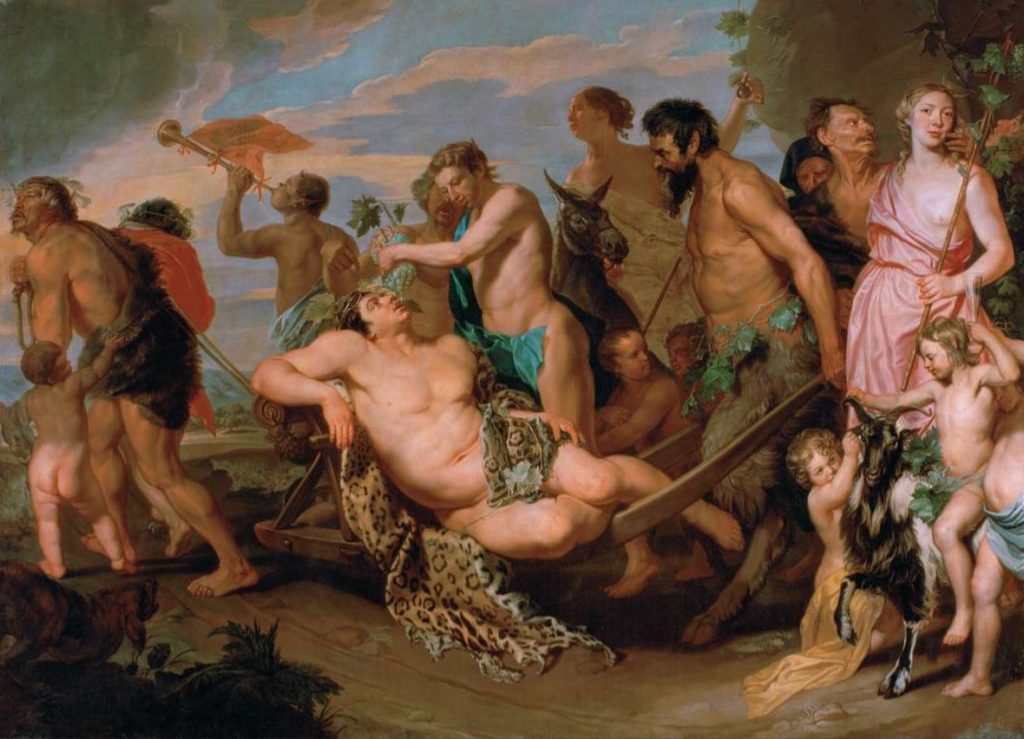
Among the commissioned works for Archduke Leopold Wilhelm, Michaelina decided to create an ambitious and provocative masterpiece—a sensual painting of Bacchus and his entourage. In the painting, Bacchus reclines on a makeshift bed, partially covered by a spotted cloth, while his gaze and open mouth express a sensuality directed at a young man offering him grapes. Surrounding Bacchus are satyrs, mythological creatures, and men, women, and children. Notably, the figure standing out prominently in the painting is a woman on the right—brightly dressed, revealing a breast, and confidently meeting the viewer’s gaze. This woman is none other than Michaelina Wautier herself.
Through this bold portrayal, Michaelina made a powerful statement, asserting her agency as a woman artist. She defied societal expectations and proudly depicted a naked man, challenging the notion that women were limited in their artistic subjects. By inserting herself into the painting, Michaelina further emphasized her defiance and refusal to be constrained by societal norms and expectations.
Recognition and Legacy:
Archduke Leopold Wilhelm was highly pleased with Michaelina’s painting, hanging it prominently among his extensive collection of 1300 artworks. While Michaelina achieved recognition and appreciation during her lifetime, the story of many female artists of her time, she was ultimately forgotten after her death. In the years that followed, most of her paintings were mistakenly attributed to her brother, overshadowing her significant contributions to the art world.
Conclusion:
Michaelina Wautier’s remarkable journey as a successful female artist in the 17th century stands as a testament to her talent, determination, and refusal to conform to societal expectations. By breaking free from the limitations