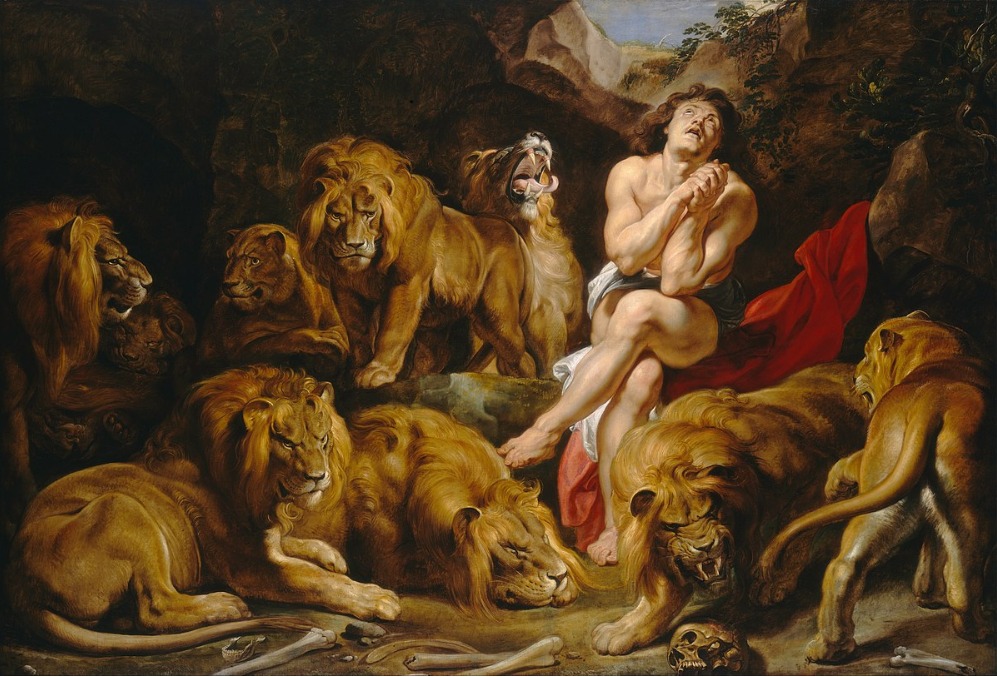
Lion’s Den Revelation
“Daniel in the Lions’ Den,” painted by Peter Paul Rubens in 1614, is a masterpiece that tells the biblical story of Daniel, who was thrown into a den of lions for defying a decree that forbade him from praying to the God of Israel. Rubens, a renowned Flemish artist, was known for his humanistic education, his study of classical literature, and his extensive travels, which included an eight-year trip to Italy, where he studied the works of great artists like Titian, Verona, and Tintoretto.
Born to a Calvinist father who fled with his family from Antwerp to Cologne to escape religious persecution, Rubens grew up as a Catholic after his father’s death and his return to Antwerp. Throughout his career, religion played a prominent role in his work, as the church and aristocracy were his major patrons. As his career progressed, Rubens became a leading artist of the Catholic and Counter-Reformation movement in painting.
The period between 1609 and 1621 is considered formative for Rubens, during which he reached the peak of his career. Between 1611 and 1614, he worked on important projects like decorating altars in the Antwerp Cathedral, establishing himself as the most significant painter in Flanders. Amidst his busy schedule, Rubens found time to work on “Daniel in the Lions’ Den,” a painting that wasn’t pre-ordered by anyone, making it quite rare for a sought-after artist like him to create a piece without prior commission.
Rubens never saw lions in real life, but it is said that he used lions kept in Morocco as models to study their anatomy and movements, which he then incorporated into the painting. The biblical story of Daniel’s unwavering faith and his sacrifice for the sanctification of God held personal significance for Rubens, perhaps as a tribute to his father, who had to flee Antwerp due to religious persecution.
The book of Daniel, included in the “Ketubim” of the Bible, was written in Aramaic and Hebrew and covers the period between the exile in Babylon and the days of Darius II, King of Persia and Media. Daniel is depicted in the painting as a young man, but according to the scriptures, he would have been around 80 years old at the time of the event. Daniel was renowned as a dream-solver, but his message always emphasized that ultimate power rests in the hands of God alone.
In 1618, according to detailed business records left behind by Rubens, he exchanged “Daniel in the Lions’ Den” with a large Flemish art dealer in Antwerp for 100 classical sculptures and a substantial amount of cash. The painting and a sketch of the upper lion used in its creation were later donated to the National Gallery of Art in Washington by Elisa Mellon Bruce, daughter of the billionaire banker and diplomat, Andrew W. Mellon.
The painting’s display next to the lion sketch at the National Gallery of Art has drawn great interest from art critics. Many consider the sketch to be a perfect work in its own right, surpassing the already magnificent oil painting. Rubens’s ability to depict movement, color, light, drama, and even sensuality in the lion sketch showcases his artistic prowess at its peak.
“Daniel in the Lions’ Den” remains a powerful and emotive depiction of a biblical story that holds religious and personal significance for the artist. Peter Paul Rubens’s masterful handling of both religious and secular subjects continues to captivate viewers and inspire admiration for his timeless artistry.