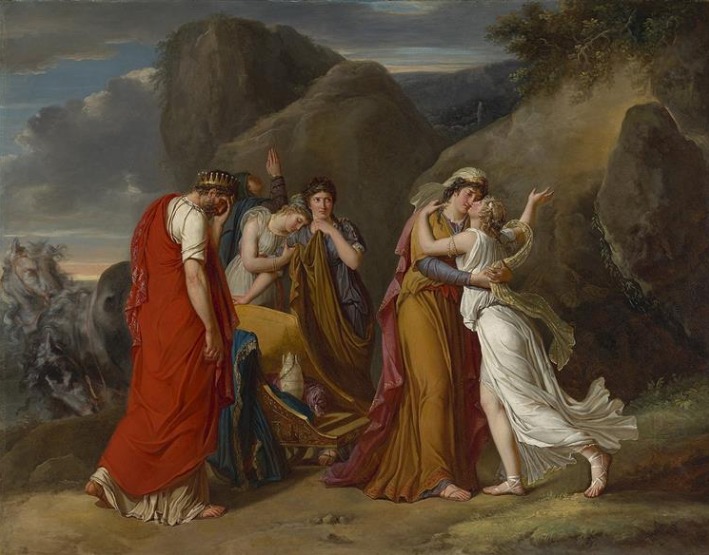
Marie Gamemin’s Triumph
Marie Gamemin: A Trailblazing Artist Defying Tradition and Prejudice
On a warm day in May 1783, the streets of Paris echoed with joy as Marie Gamemin and her sister Marie Elizabeth celebrated the success of their painting teacher, Elisabeth Vizier Le Barne. In a society where the art world was dominated by men, Elisabeth’s achievement of gaining official membership in the prestigious Royal Academy of Artists and Sculptors in Paris was a groundbreaking moment. This membership granted artists the privilege of presenting their paintings at the esteemed biennial exhibition called “The Salon” held at the Louvre.
Proud of her teacher’s accomplishments, young Marie, who had been studying under Elisabeth since the age of thirteen, began to envision her own future as a member of the Royal Academy. The opportunity to exhibit at “The Salon” was a dream that motivated her to pursue her passion for art.
The Exclusive World of “The Salon”
“The Salon” was no ordinary art exhibition; it was a grand event sponsored by the French government and held in the opulent “Salon d’Apollon” within the Louvre Palace. Only artists who were members of the Royal Academy of Painters and Sculptors in Paris were allowed to display their works at this prestigious exhibition. The event attracted significant attention, with catalogs printed and articles about the artists and their works published in newspapers. To have one’s art exhibited at “The Salon” was to receive a royal seal of approval, a promise of recognition and success.
A Disheartening Rejection
At the age of fifteen, Marie Gamemin felt ready to seize her moment and applied for membership in the Royal Academy. However, her excitement quickly turned to disappointment when her application was rejected. The members of the academy declared that henceforth, no more women would be admitted. Despite this setback, Marie remained undeterred, determined to forge her path in the world of art.
Taking Flight: Jacques-Louis David and Historical Painting
Elisabeth’s studio may have closed, but Marie’s artistic journey was far from over. She made a bold decision to enroll in studies with the renowned painter Jacques-Louis David, an influential figure in the Neoclassical movement. Under his guidance, Marie experienced a transformative shift in her art. The genre of historical painting, considered the most esteemed at the time, captivated her imagination.
In the late 18th century, it was widely believed that historical painting was a domain exclusive to men, as they were thought to possess the necessary education and imagination for such ambitious themes. Women, on the other hand, were relegated to painting landscapes, still life, and portraits. However, Marie was determined to challenge these rigid norms and break the myth. She saw no reason why women couldn’t excel in the genre of historical painting, and she set out to prove this belief wrong.
A Pivotal Moment: “Psyche Separated from Her Family”
In 1791, the French Revolution ushered in a period of transformation and upheaval in French society, including the art world. “The Salon” exhibition was opened to artists irrespective of their gender or academic background. This newfound opportunity proved to be the breakthrough Marie had been waiting for.
Her painting titled “Psyche Separated from Her Family” was selected for the 1791 Salon Exhibition. The subject of the painting was inspired by the Roman mythology of Princess Psyche, the youngest of her three sisters, whose beauty was so captivating that she was likened to “the new Venus.” However, her beauty brought her only fear from potential suitors, as they believed her beauty was too great for any mortal man. Desperate, her parents sought the counsel of Apollo, who prophesied that Psyche’s husband would be a powerful and destructive monster. To save their kingdom, Psyche was taken to a mountaintop to await her husband’s arrival.
Marie’s deliberate choice of this subject matter had a profound relevance to the revolutionary ideals in Paris. The painting depicted the poignant moment of Psyche bidding farewell to her family before facing her uncertain fate. With meticulous attention to detail, Marie captured the emotions of each character and the dramatic setting.
Rising Recognition and Personal Challenges
In 1793, at the age of twenty-five, Marie married Pierre Vincent Benoit, a banker and politician. The same year, Pierre was accused of plotting to rescue Marie Antoinette from prison, leading him to flee France. Despite the turmoil, Marie’s career continued to flourish. In 1804, she won a prestigious medal at “The Salon” Exhibition, earning recognition from none other than Napoleon Bonaparte himself. The Emperor offered Marie a monthly salary and an apartment, catapulting her to greater prominence. She became the primary breadwinner for her family and even became a teacher for aspiring artists in her studio.
However, with the fall of Napoleon, Marie faced personal challenges and soci