Scandalous Ballet Secrets
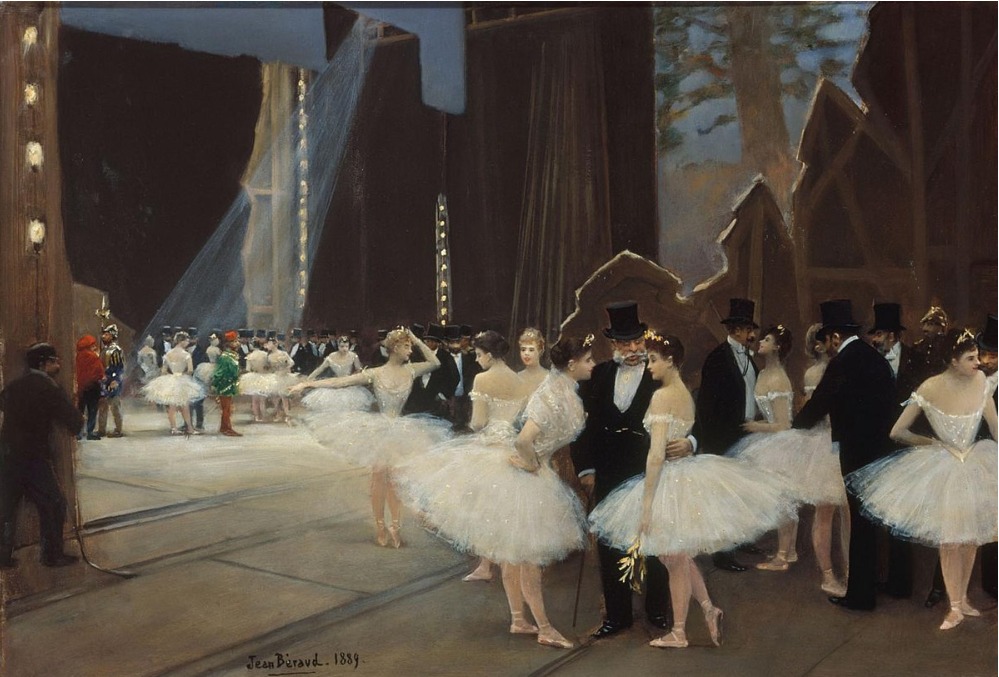
“Backstage at the Opera,” created by French painter Jean Béraud in 1889, is a painting that, at first glance, appears refined, beautiful, and impressive. However, as one delves into the story behind it, it becomes one of the most shocking paintings in the history of art. Jean Béraud was renowned for his depictions of Parisian life and the nightlife of the bourgeois society during the Belle Époque. His realistic portrayals of places like Champs-Élysées, cafes, Montmartre, and the banks of the Seine River captured the vibrant and sometimes unruly spirit of the City of Lights. Although Béraud was popular in his time, his fame has diminished somewhat in contemporary art history. However, he is credited with exposing the dark underbelly of the famous Paris Opera Ballet.
The painting “Backstage at the Opera” measures 200×170 cm and was exhibited in a New York gallery in 1891. A diligent American journalist named James Morris, after hearing the painter’s explanations about the painting, was so intrigued that he convinced his editor to send him to Paris to investigate the shocking story of what goes on behind the scenes at the Opéra Garnier. Morris’s article, which appeared on the cover of SCRIBNER’S magazine in January 1892, created a sensation. The magazine chose the title, “Rich Men Turned the Famous Paris Opera Ballet into a Brothel!”
In the article, Morris reveals disturbing details from testimonies of individuals with personal knowledge about the activities behind the scenes at the Opera Garnier. One such testimony came from the Comte de Mogny, who described his personal experiences as well as those of dancers in the opera’s ballet troupe. It became evident that many men, particularly the newly rich, subscribed to the opera not necessarily for the music or dance but to establish or continue intimate relationships with the young, beautiful ballerinas who performed twice every night. Behind the scenes, these men acted as patrons who bought sexual favors from the ballerinas. Shockingly, these talented and beautiful dancers were forced to live in squalid conditions and often reached the brink of starvation.
The article also revealed that everyone in Paris was aware of this phenomenon and gave these patrons a derogatory nickname: “Abbonés.” The sensational revelation was that when Charles Garnier began planning the opera house in 1860, he was asked to include a separate and special entrance for holders of expensive seasonal premium tickets. This special entrance led to a magnificent hall called “Foyer de la Danse,” which was intended for ballet dancers to warm up and practice before and during performances. However, it was mainly used to facilitate encounters between patrons and the ballerinas.
The Garnier Opera Palace, inaugurated in 1875, had a dark parallel world behind its stunning neo-baroque facade, where middle-aged men, respectable in appearance and rich, patronized young girls, some as young as 15 or 16, who had come to Paris with dreams of conquering the stage. Tragically, many of these aspiring dancers fell into abject poverty due to the high cost of living in Paris.
The entrance of the palace, called Foyer de la Danse, became a “closed members’ club” where patrons socialized with the dancers, conducted business deals, and engaged in sexual activities. Count de Mogny testified that the lobby had become a real “meat market.” The magazine noted that the power of these patrons was undoubtedly used to rescue girls from poverty, house them in comfortable rooms, and finance private ballet lessons to improve their chances of advancing in their careers. For many ballet dancers from poor backgrounds, relationships with wealthy patrons were often their only chance for success.
It was revealed that Edgar Degas, in his paintings “L’Étoile” and “The Curtain,” had alluded to the presence of these patrons behind the scenes, but he did not delve deeper into the subject or expose it fully. Some even claim that Degas was granted special privileges at the Paris Opera, including access to behind-the-scenes activities, for brokering deals between potential patrons and the opera’s management.
While Degas’s paintings of dancers remain beautiful and refined, exposing this hidden reality is a sobering reminder of the harsh and sad reality experienced by these young dancers. The shocking revelation in James Morris’s article prompted the Opera Garnier to respond by simply stating that their institution complies with French laws.
It is said that “Backstage at the Opera” was offered for purchase to the Musée d’Orsay in Paris, where Edgar Degas’s “L’Étoile” is displayed, but the museum decided not to acquire the painting. This refusal may be a reflection of the discomfort in confronting the dark history that lurks behind the grandeur of the Paris Opera Ballet and the Belle Époque era.