Tensions of Freedom
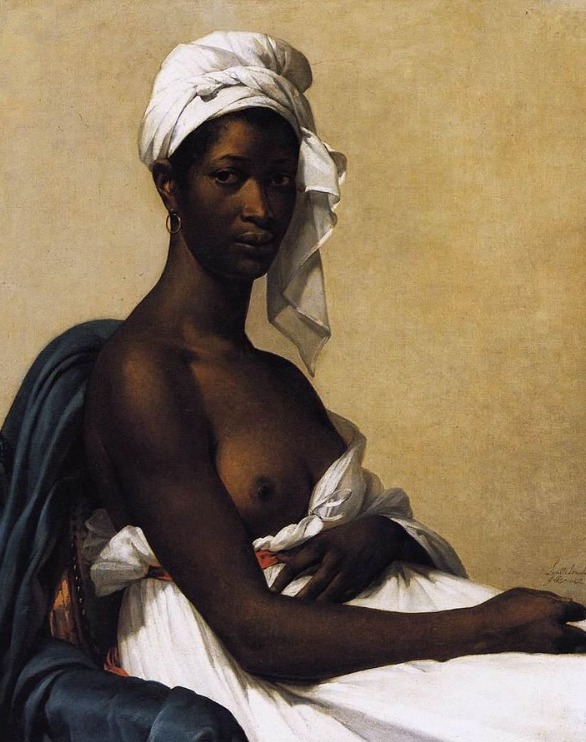
“Portrait of a Black Woman,” painted in 1800 by French artist Marie-Guillemin Benoit, portrays Madeleine, a slave from Guadeloupe who worked for the painter’s brother-in-law. This portrait is a striking representation of the tensions and contradictions surrounding race, power, and social status during the late 18th century. While the composition and elements of the painting align with traditional portrait conventions, the subject’s presence and her portrayal challenge societal norms of the time. This essay explores the significance of Benoit’s portrait, delving into the subtle symbols that convey the power dynamics and the temporary freedom experienced by Madeleine.
A Striking Representation:
In “Portrait of a Black Woman,” Madeleine is depicted in a noble position, seated in a velvet armchair with her hair elegantly styled. Her gaze meets the viewer’s, and she wears gold earrings, emphasizing her dignity and self-assuredness. However, the dichotomy between her noble appearance and her actual low status as a slave creates a tension within the painting. During the 18th century, it was highly unconventional to depict common people in portraits, especially black women, particularly in luxurious attire and adopting poses associated with white nobility.
Subverting Expectations:
The unconventional nature of Benoit’s portrait is highlighted by contemporary viewers’ reactions. When the painting was first exhibited, viewers were shocked by the “white hand that painted such a black picture.” The French Revolution had occurred a decade earlier, but the ideals of equality were yet to be fully realized. While slavery was abolished in France in 1794, the constant threat of its reinstatement persisted. The scarf wrapped around Madeleine’s head and the gold earring she wears serve as visual markers of her origin and indirectly allude to her recent experience as a slave.
The Weight of Slavery:
Perhaps the most poignant detail in the portrait that underscores the weight of slavery on Madeleine’s shoulders is her bare chest. In the 18th century, nobility was never portrayed with exposed breasts as it was deemed inappropriate. Madeleine’s bare chest echoes the representations of black individuals in engravings from the late 18th century, which were created as part of the abolitionist movement. These engravings often depicted black people naked or partially clothed, reflecting their state when they were forcibly taken from Africa to the Antilles as slaves.
Temporal Freedom and Impending Oppression:
Madeleine’s pose in the portrait symbolizes the temporary and relative freedom she enjoyed during a brief period before slavery was reestablished in law. Slavery was reintroduced by Napoleon I in 1802 and was only permanently abolished in 1848. While her bare chest signifies the oppression imposed upon her, her dignified posture expresses the limited freedom she experienced before the reestablishment of slavery. Benoit’s portrait thus captures the complex interplay between power and oppression, giving a voice to a marginalized individual within the societal norms of the time.
Conclusion:
Marie-Guillemin Benoit’s “Portrait of a Black Woman” is a powerful and thought-provoking artwork that challenges the prevailing norms of the late 18th century. By depicting Madeleine, a black woman, in a noble position with luxurious attire, Benoit subverts expectations and confronts the viewer with the tensions between power and oppression. The symbolism embedded within the painting, such as Madeleine’s bare chest and the visual references to her origin and recent history as a slave, further deepen the narrative. Through this portrait, Benoit sheds light on the complex realities of racial dynamics, societal expectations, and the struggle for freedom during a tumult