The Art of Caillebotte
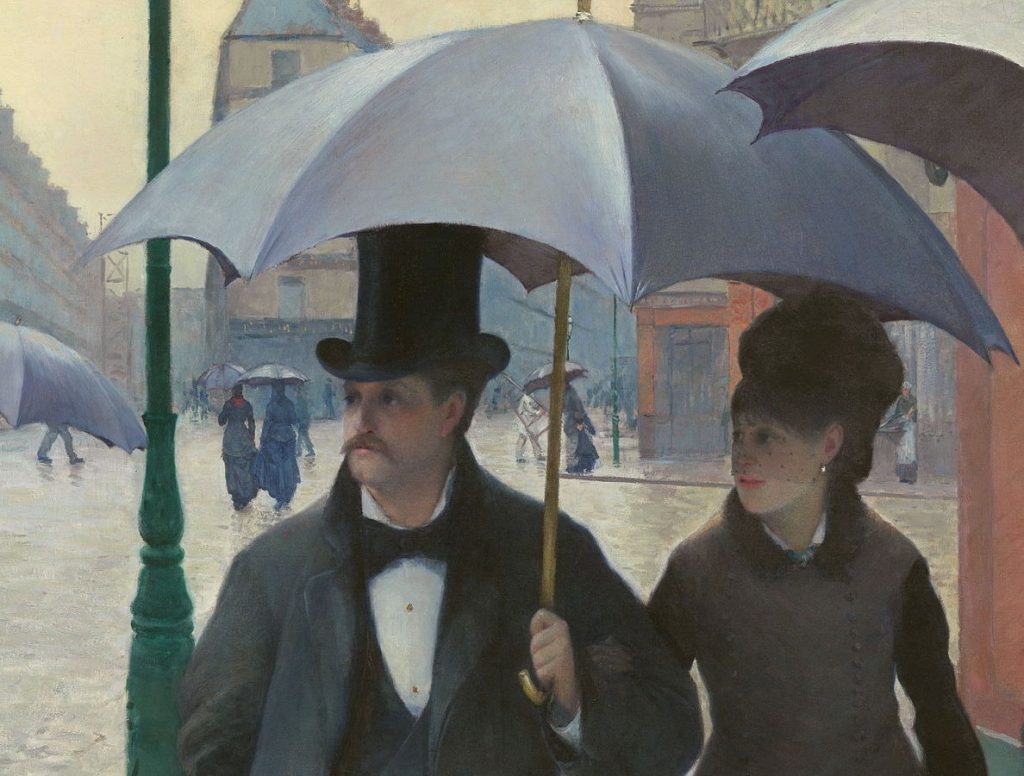
Gustave Caillebotte (1848-1894) is often remembered in the history of art as a benevolent friend and patron of the Impressionist movement. However, a deeper examination of his works reveals him to be a fascinating artist in his own right. One of his most significant paintings, “Street in Paris, a rainy day,” created in 1877, showcases the depth of his artistic vision and unique expression on canvas.
The painting portrays a meeting of streets in the heart of the 8th arrondissement of Paris, near the “Saint Lazare” train station in the north of the city. Measuring 2.76 x 2.16 meters, the artwork was exhibited at the “Duran Roel” gallery as part of the 3rd Impressionist exhibition. It stood out from the typical Impressionist style due to its remarkable realism and Caibotte’s preference for clear lines of color over broad brushstrokes. This attention to detail and linearity in his paintings reflects his interest in photography, a medium he admired as much as the works of his fellow artists.
Gustave Caillebotte specialized in urban impressionism, depicting scenes of everyday life in the streets of Paris. “Street in Paris, a rainy day” captures a couple under an umbrella, dressed in contemporary Parisian fashion, suggesting they belong to the bourgeois class. In contrast, the figures in the background appear to be working-class individuals, including a housekeeper and a worker carrying a ladder.
Despite the bustling crowd depicted on the canvas, a prevailing sense of alienation and loneliness pervades the scene. Most of the figures seem preoccupied, lost in their thoughts, and emotionally distant from one another. One art critic aptly remarked, “The umbrella not only protects them from the rain but also from each other.” This sense of isolation and melancholy is a hallmark of Caillebotte’s urban paintings, elevating them to the pinnacle of his important body of work.
Emile Zola, a prominent literary figure and supporter of the Impressionists, was the first to recognize the depth of Caillebotte’s oppressive urban impressionism. In a laudatory review of the artist’s work, Zola praised Caillebotte for delving into the soul of the passers-by on the city streets, capturing their emotional state amidst the bustling metropolis.
Gustave Caillebotte’s journey as an artist was not without its challenges. In 1875, he presented his first work, “The Parquet Gluers,” at the main salon of Paris. The painting depicted simple workers gluing parquet in a magnificent building, highlighting the suffering of the poor in French society. However, the work received harsh reviews, leaving Caillebotte feeling rejected and humiliated. Ironically, “The Parquet Gluers” is now displayed as a masterpiece in the Musée d’Orsay in Paris.
Following this initial setback, Caillebotte found kinship with the Impressionists, who, like him, faced rejection by critics and limited sales of their works. With his father’s passing, Caillebotte inherited immense wealth, and he began supporting and befriending the Impressionists, purchasing their paintings and funding exhibitions.
Caillebotte’s collection included works by Claude Monet, Pierre-Auguste Renoir, Edgar Degas, and others, which he acquired to help the struggling artists gain recognition. He not only exhibited his own paintings at Impressionist exhibitions but also organized and financed several of these shows, becoming an enthusiastic supporter of the movement.
His artistic style continued to revolve around social conceptual subjects, with a focus on depicting the alienation, loneliness, and dissatisfaction experienced by many French people during the Belle Epoque era. Caillebotte maintained the photographic realism of his urban paintings, creating a unique style with light effects and personal touches that set his works apart.
In 1893, a year before his death, Caillebotte presented a series of 26 flower and still-life paintings at the Windstein Gallery. In his will, he bequeathed his vast collection to the state, most of which is now displayed in the Musée d’Orsay in Paris.
As an art patron and philanthropist, Gustave Caillebotte’s legacy lives on as one of the key supporters of the Impressionist movement. However, when exploring his own works, we discover a talented, original, and daring artist who used his personal wealth and influence to champion the artistic endeavors of his peers while also creating thought-provoking and emotionally charged masterpieces of his own. His unique perspective on urban life and ability to convey deep emotions through his paintings make Gustave Caillebotte an enduring figure in the annals of art history.