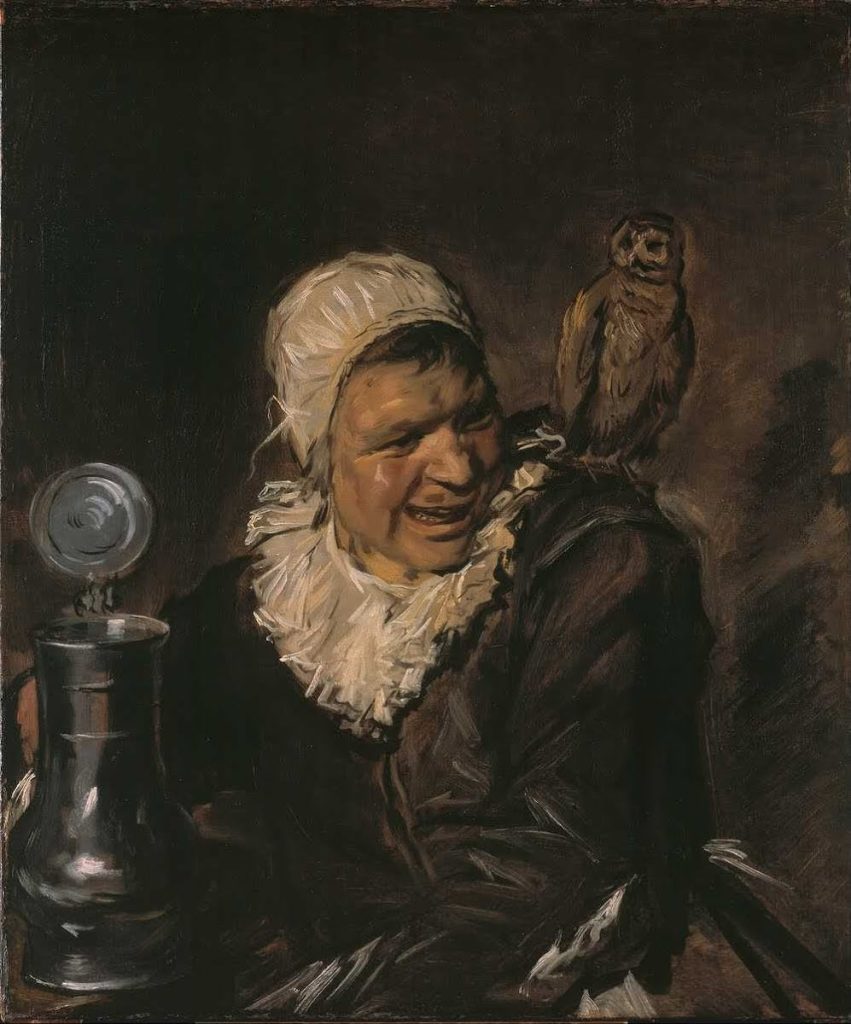
The Witch’s Portrait
Frans Hals (1582-1666) was a prominent artist of the Dutch Golden Age and a leading figure in the Haarlem school of painting during the Baroque period. One of his notable paintings is titled “Malle Babbe,” created in Haarlem, Holland, in 1633 when Hals was 51 years old. The painting portrays an elderly woman sitting at a table, seemingly engaged in conversation with an unseen person beyond the canvas’s edge. She lifts the lid of a large beer mug with her right hand, while an owl perches on her left shoulder. The woman’s attire reflects the modest Protestant fashion of Harlem in the 1730s, with faded and simple clothing.
“Malle Babbe” is an oil painting on linen canvas, measuring 75 x 64 cm. Interestingly, Hals never exhibited this portrait and kept it in his personal collection until his death. The name of the painting, “The Witch of Harlem,” was mistakenly given by the executors of Hals’s estate, who found Hals’s faded handwriting in Flemish on the back of the frame. The inscription read “Hille Bobbe van Harlem.” The presence of the owl, symbolizing wisdom and mystery, likely influenced their perception of the painting as depicting an imaginary witch conjured by the artist’s imagination or inspired by encountering a woman in the streets of Harlem.
Further research shed light on the true identity of the subject. Historical records from Haarlem revealed a woman named Barbara Klaas, also known as Malle Babbe, who was hospitalized in the sanatorium HET DOLHUYS, located outside the city walls of Haarlem, in 1630. It was discovered that one of Frans Hals’s sons, Peter Hals, was also a patient at this sanatorium during that time. Therefore, it is speculated that Hals encountered Barbara Klaas during his son’s hospitalization and chose to paint her out of personal interest or curiosity about her nickname. It is known that the real Malle Babbe suffered from mental retardation and was prone to drunkenness, and the presence of the owl on her shoulder symbolizes drunkenness in Dutch culture. In fact, there is a Dutch proverb that translates to “Drunk as an owl.”
The painting exhibits Hals’s characteristic free brushwork, which was common in his portrait paintings that sustained his livelihood. Frans Hals is regarded as the greatest artist of the Haarlem school and a prominent representative of the Dutch Golden Age. Born in Antwerp in 1582 to a Protestant family, Hals witnessed the ongoing rebellion of the 17 provinces, known as the “Low Countries,” against the Spanish Empire. His family, like many other Protestants, fled to Haarlem when he was just three years old to seek refuge from the Spanish rule imposed on Antwerp.
Hals displayed remarkable talent from a young age and later studied under Carl Van Mander, a renowned art teacher in Haarlem. This education provided Hals with the technical skills and mastery of color illusion, allowing him to create captivating portrait paintings. His style combined detailed realism with vibrant and iridescent colors, occasionally emphasizing a dominant hue, as seen in “Malle Babbe” with its predominant brown tones. Frans Hals’s style is considered innovative and influential, earning him great demand for his works and establishing him as a successful artist. In 1644, he was elected as the head of the Haarlem Painters’ Guild.
However, later in his life, Hals faced financial difficulties due to failed investments, excessive drinking, and a tendency to squander his wealth on the pleasures of city life.