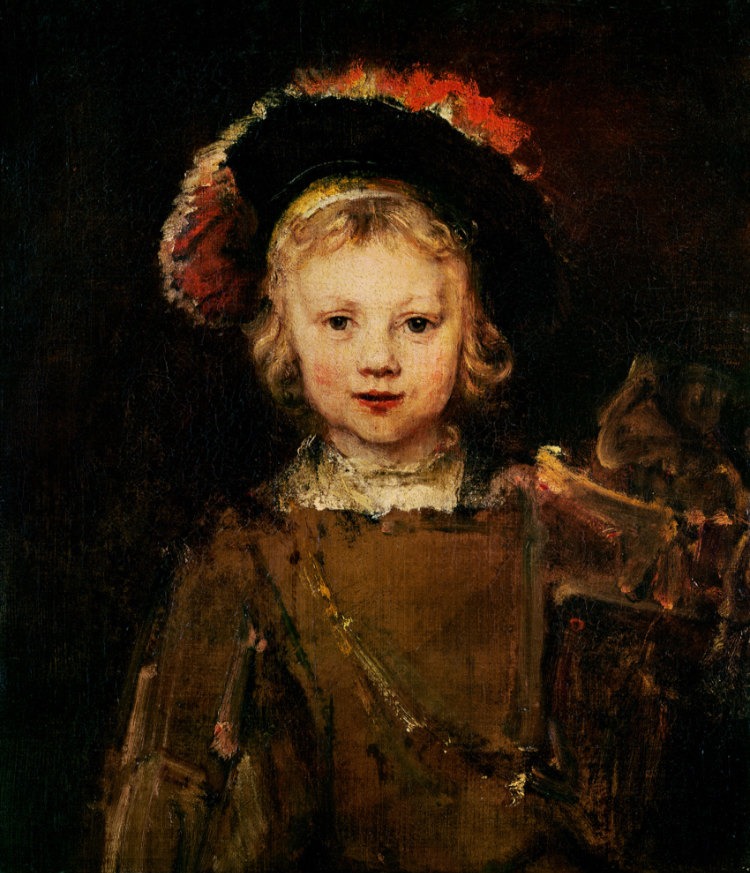
Titus Unveiled
The remarkable painting before us was created by the renowned Dutch artist Rembrandt van Rijn in 1650. Titled “Titus van Rijn,” the oil on canvas artwork depicts his son, who was nine years old at the time. Measuring 65 x 56 cm, this painting is likely the first in a series where Rembrandt portrayed his fourth and only surviving son, born to him and his late wife, Saskia van Eulenburg.
Titus, named after Saskia’s deceased sister Tietje, was born in 1641 in Amsterdam and became a prominent subject in his father’s paintings during the 1640s and 1650s. Unfortunately, Saskia passed away in 1642 from tuberculosis, leaving behind four children. Among them, only Titus survived, and his mother’s death occurred just months after his birth. Thus, Rembrandt and Saskia’s marriage lasted a mere eight years.
In contrast to Saskia’s affluent background, Rembrandt was the youngest and ninth child in a modest and impoverished family. However, due to his exceptional talent, he was given the opportunity to study art at the university in Amsterdam when he was just 14 years old. Soon, Rembrandt gained popularity as a portrait painter and achieved great success. However, he was known for his extravagant and wasteful lifestyle, eventually leading to financial troubles.
After Saskia’s death, Rembrandt fell into heavy debt, exacerbated by his significant investment in constructing a large house in the costly Jewish quarter of Amsterdam. To fund this project, he resorted to borrowing money at exorbitant interest rates from the “grey market” of Amsterdam. Amid his financial struggles, Rembrandt formed a domestic partnership with a young maid named Hendricja Stoffels, who helped raise Titus. They lived as a couple, but Rembrandt did not marry her to protect his deceased wife’s inheritance. Hendricja bore Rembrandt a daughter named Cornelia in 1654 when he was 48 years old.
Due to his “unconventional” relationship with Hendricja, Rembrandt was expelled from the Calvinist church for “living in sin.” Two years later, in 1656, Rembrandt faced bankruptcy. Subsequently, Hendricja and Titus were declared trustees of his assets, establishing a pseudo-business company. Rembrandt became an employee of this company, functioning as an art dealer who primarily sold his own paintings to evade debt repayment.
In 1663, Hendricja passed away, and a mere five years later, Titus also succumbed to illness, likely tuberculosis, at the age of 27. Strangely, before his death, Titus bequeathed all his assets and possessions back to his father. Tragically, a year after Titus’s passing, his young widow and their daughter also died, possibly from tuberculosis or fever. The relationship between Rembrandt and his daughter Cornelia, born to Hendricja, became strained. Cornelia eventually married a Dutch merchant and settled in Indonesia, where she also passed away.
Rembrandt himself died in 1669 at the age of 63, leading a lonely, childless, and destitute life. His possessions were seized to settle his remaining debts, leaving him with minimal balance. However, this is where the fascinating story of the painting in question takes a captivating turn.
In the complex tapestry of Rembrandt’s life, the painting was lost and disappeared for 175 years. It wasn’t until a gloomy winter day in 1815 that George Barker, a well-known British art curator and restaurateur, found himself stranded due to stormy weather. Seeking refuge in a small inn near The Hague,