Toulouse – Lautrec’s Last Series
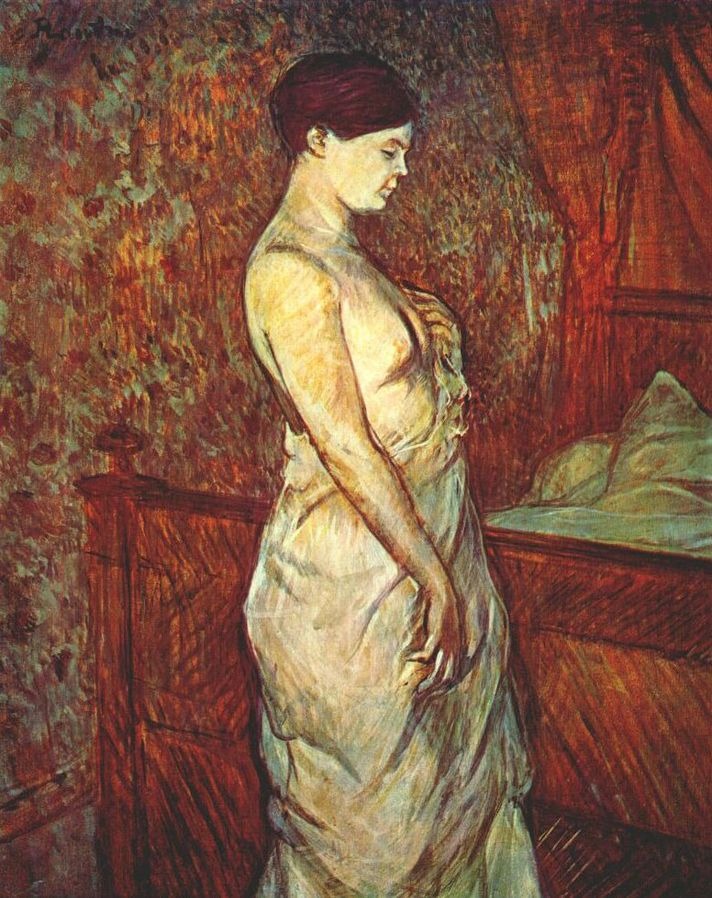
Henri de Toulouse-Lautrec, a renowned Post-Impressionist artist, created his final painting just days before his death. Titled “Le Coucher” in French, it was also referred to as “Madam Poupoule in Chemise by Her Bed” in England. Completed in 1899, the painting measures 98 x 78 cm and is an oil painting on canvas. Unfortunately, Toulouse-Lautrec’s health had been deteriorating due to alcohol poisoning, liver failure, and complications from syphilis, which he contracted two years prior.
The subject of the painting, Madame Poupoule, was the artist’s last model for a series of paintings depicting a woman preparing for sleep. Over a period of two years, between 1897 and 1899, Toulouse-Lautrec painted Madame Poupoule in various poses and locations within her home, often near her small bathroom or bedroom. Most of the paintings from this series found their way into private collections around the world. After the artist’s death, his mother brought this particular painting back to their hometown of Albi, where it became part of the extensive collection displayed in the museum dedicated to Toulouse-Lautrec’s works.
The story behind the creation of this series of paintings and the origin of the name “Le Coucher” is intriguingly connected to the invention of motion pictures. Before the advent of cinema, the precursor known as silent films projected moving images without recorded sound. In 1894, Edison’s laboratories in London developed celluloid film, enabling the projection of consecutive pictures in a laboratory setting. However, public screenings of films were yet to be realized.
The Lumière brothers, pioneers in film projection, were the first to publicly demonstrate a film projector in France in 1895. Their screening, held at the Grand Café on rue Capuchins in Paris, showcased three one-minute films, attracting over 2,000 enthusiastic viewers. This event marked a significant shift from individual screenings to mass public screenings, laying the foundation for the film industry as we know it today.
With the emergence of film, directors and distributors recognized the artistic and commercial potential of motion pictures. One such distributor, Georges Méliès, a former employee of the Lumière brothers, began producing and directing his own films, including the first erotic film and the first science fiction film in history. Toulouse-Lautrec, fascinated by the new medium, found particular inspiration in the first erotic film, titled “Le Coucher de la Mariée” (The Bride’s Bed).
“Le Coucher de la Mariée,” released in 1896, was a seven-minute black-and-white film depicting a woman slowly undressing behind a transparent curtain while a man, separated by the curtain, observed her as if reading a newspaper. Toulouse-Lautrec drew inspiration from this film for his last series of paintings, capturing women undressing and preparing for sleep. Unfortunately, Toulouse-Lautrec’s collapse and subsequent hospitalization interrupted his work, and he passed away in 1901 at the age of 36. His mother, the Countess of Albi, took charge of his burial near the family estate and meticulously collected and cataloged his extensive body of work.
Despite exhibiting in few important exhibitions during his lifetime, Toulouse-Lautrec’s works have since gained significant recognition and are now considered valuable masterpieces displayed in renowned museums worldwide. In addition to his contributions as a Post-Impressionist artist, Toulouse-Lautrec’s art nouveau style posters and advertisements are seen as precursors to pop art, influencing artists like Andy Warhol. Over 1,000 of his works, including oil paintings, watercolors, lithographs, and photographs, are showcased in the T