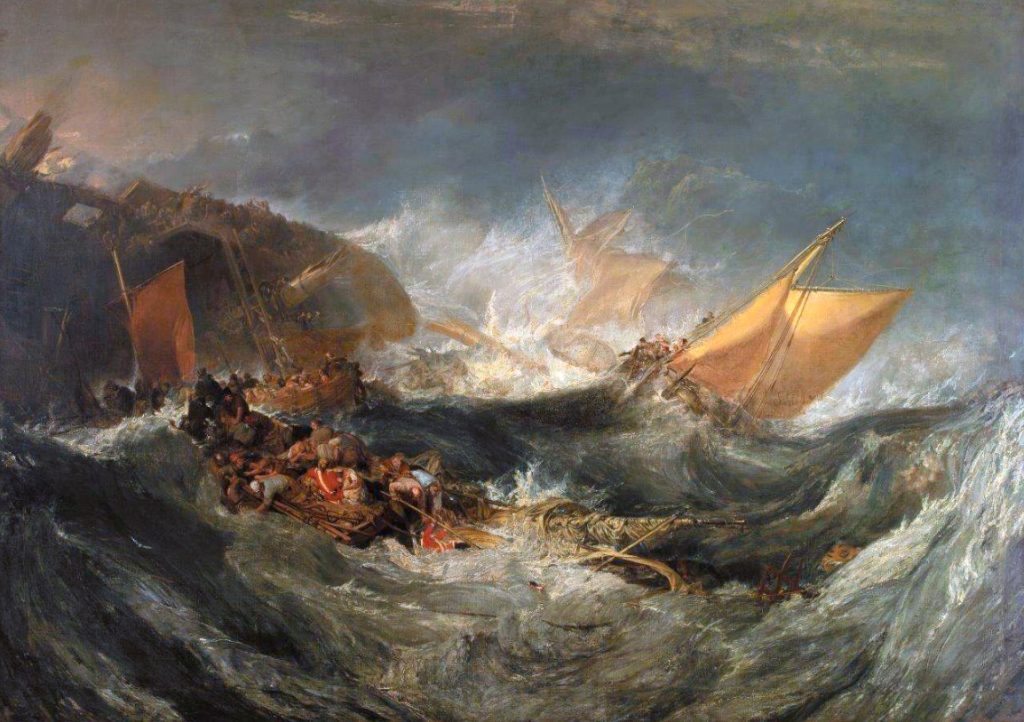
Turner’s Sublime Legacy
Joseph Mallord William Turner, also known as William Turner, was an English Romantic painter, printmaker, and watercolorist who gained recognition for his expressive coloring, imaginative landscapes, and turbulent marine paintings. With a vast collection of over 550 oil paintings, 2,000 watercolors, and 30,000 works on paper, Turner’s artistic legacy continues to inspire and captivate audiences. His ability to evoke the sublime, a concept characterized by the experience of awe, fear, and transcendence, sets him apart as a visionary artist. This essay explores Turner’s life, his artistic contributions, and his masterful depiction of the sublime, with a focus on one of his notable works, “The Slave Ship.”
Life and Career:
Joseph Mallord William Turner was born on April 23, 1775, in Maiden Lane, Covent Garden, London. Coming from a modest lower-middle-class family, Turner maintained his working-class accent throughout his life, consciously avoiding the trappings of success and fame. Recognized as a prodigious talent, he enrolled at the Royal Academy of Arts at the age of 14 and exhibited his first work at 15. Turner’s early artistic pursuits included architectural drafting alongside his studies at the Academy. He gained a steady income from commissions and sales, although his contrary nature often made him reluctant to accept them. In 1804, he established his own gallery and later became a professor of perspective at the Academy in 1807, where he lectured until 1828. Turner embarked on numerous journeys throughout Europe, documenting his experiences in voluminous sketchbooks.
Turner’s Artistic Vision:
Turner’s artistic style evolved over the years, reflecting his exposure to various writings and ideas, including the concept of the sublime. Although he had a classical upbringing, his visual language transformed into a form akin to abstract painting, predating the emergence of abstract art. Turner’s unique ability to emphasize the different layers of the sublime and visually express its elusiveness set him apart from his contemporaries.
“The Slave Ship” and the Sublime:
One of Turner’s paintings most associated with the sublime is “The Slave Ship.” The artwork depicts an actual event that occurred in 1781, where slaves were thrown overboard during a storm. However, Turner did not portray the scene in a strictly realistic manner. Instead, he employed a technique characterized by a play of colors and spots, creating an open and blurred visual space that allows light to permeate the canvas, dazzling the viewer. The light’s diffusion makes it challenging to discern the details clearly, yet the rocking slave ship emerges from the heart of the tumultuous sea.
In “The Slave Ship,” Turner skillfully juxtaposes two terrible events on the canvas. On one hand, nature rages against the ship, threatening its occupants. The stormy sea and the fiery red sky attract the viewer’s gaze, offering a glimpse into the sublime. However, reason grounds us and reminds us of the imperceptible horror unfolding on board—the slaves thrown to their deaths despite the storm. Turner’s painting elicits a profound emotional response, as the viewer is torn between the awe-inspiring power of nature and the tragic plight of the enslaved.
Confronting the Sublime:
Turner’s portrayal of the sublime prompts viewers to confront the paradoxical nature of this concept. While the storm appears indifferent to the terror it wreaks, symbolizing an inescapable and undeniable force, we observe the scene from a safe vantage point. The storm’s impact does not harm us directly, allowing us to marvel at the strength of nature’s forces.